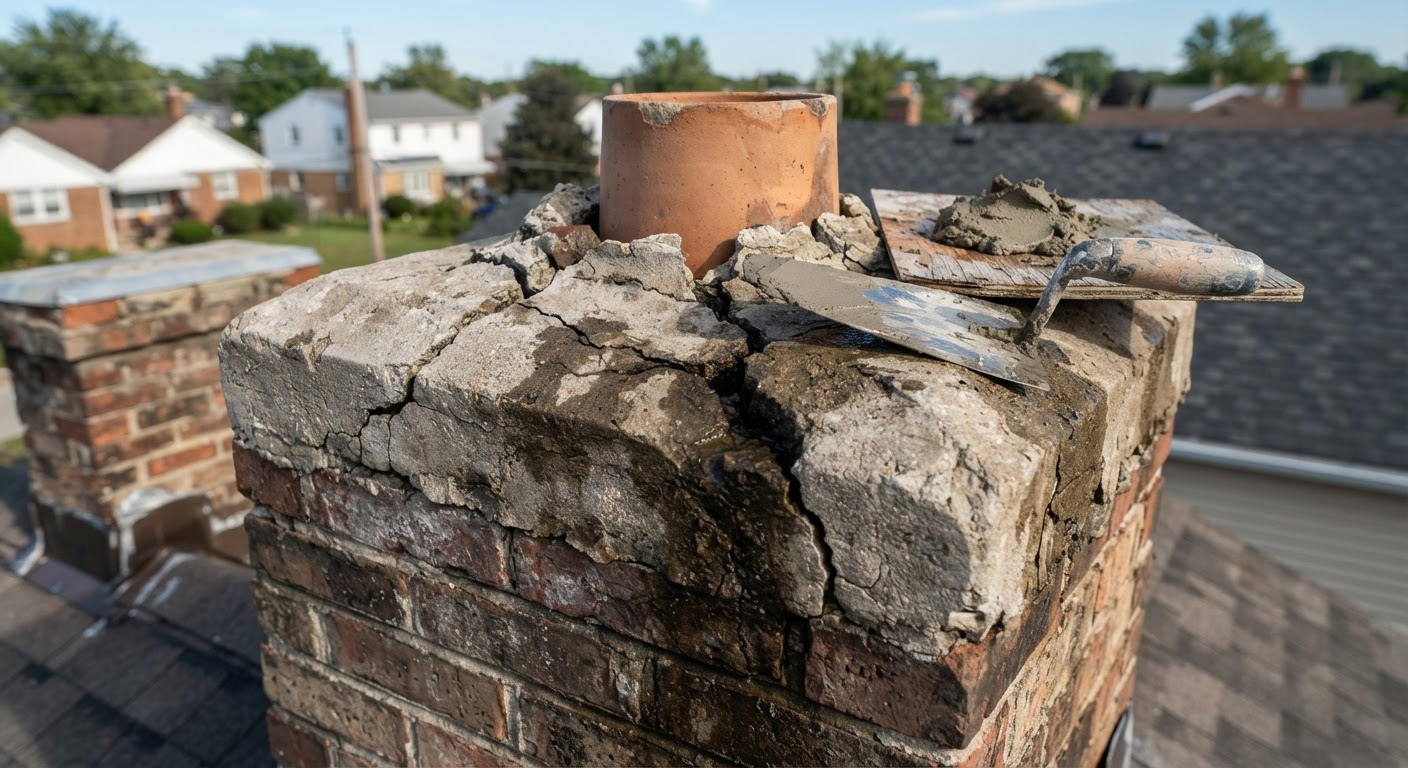
The chimney crown is the concrete slab that caps the top of your chimney, sealing the gap between the flue liner and the outer brick walls. When it cracks, water pours directly into the chimney structure, causing damage that spreads downward through the entire masonry. We repair and rebuild chimney crowns across Allen and Collin County. Call (972) 521-7225.
Fill out the form and we’ll call you back within 2 hours.
Crown Repair — Starting at $300
Water enters through crown cracks, soaks into the brick and mortar below, freezes in winter, expands, and opens the cracks further. Each year the damage compounds. What starts as a hairline crack becomes a chunk missing. What started as a $300 seal job becomes a $900 full crown rebuild — or worse, a chimney rebuild if the water damage has spread to the bricks below.
We see this pattern constantly in Allen homes built in the 1990s and 2000s. Many builders used a basic mortar wash instead of a proper concrete crown. Those mortar washes crack within 5–10 years. If your home is 15+ years old and the crown has never been inspected, there’s a very high chance it needs attention.
You can’t see the crown from the ground on most chimneys. But these clues suggest crown damage:
We check the crown during every chimney inspection and chimney sweep. If the crown needs attention, you’ll see it in the photos we take.
CrownCoat sealant application: $300–$500. Full crown rebuild (remove and pour new): $500–$1,200. Price depends on chimney size, crown condition, and accessibility. We provide exact quotes after roof-level inspection with photos.
CrownCoat sealant lasts 15+ years and is reapplicable. A properly poured concrete crown lasts 20–30 years. We recommend pairing crown work with waterproofing the chimney bricks for maximum protection.
Standard caulk doesn’t work on chimney crowns. It’s not flexible enough to handle thermal expansion and it breaks down in UV exposure within a year. CrownCoat is a specialized elastomeric sealant designed specifically for chimney crowns — it stays flexible through heat and cold cycles and blocks UV degradation.
A cap protects the flue opening but doesn’t cover the crown itself. The crown is the flat surface surrounding the flue opening — it’s still fully exposed to rain, sun, and ice even with a cap. Both a cap and a healthy crown are needed for proper water management.
We respond within 2 hours during business hours.